Plural Overlapping Dimensions Found Unobvious Due to Differing Function
April 27, 2026
In the recent appeal of U.S. Appl. No. 18/018,555 (Appeal 2026-000028), an examiner’s obviousness position was reversed by the Patent Trial and Appeal Board (PTAB) based on the examiner’s failure to set forth a factual basis for a modification of a primary reference to reflect a claim feature directed to dimensional characteristics of a claimed article.
The appealed claim recited the following:
[a] vaporization media comprising a media wall including:
a liquid face that is adjacent to and in fluid communication with an extract reservoir;
a vapor face that is adjacent to and in fluid communication with a vaporization chamber, the media wall arranged cylindrically around the vapor face; and
pores that perforate the media wall and are arranged in relation to a central axis of the media wall, the pores being substantially identical, approximately frustum-shaped, and having:
inlets located on the liquid face, the inlets having a diameter ranging from 0.3-0.7 mm;
outlets located on the vapor face, the outlets being smaller than the inlets, the outlets having a diameter ranging from 0.1-0.5 mm and configured to prevent liquid from flowing into the vaporization chamber while allowing vapor into the vaporization chamber; and
surfaces of the pores that are made of ceramic and are substantially nonporous.
The initially rejected claims lacked the inlet-outlet features and dimensional features regarding the pores, but were rejected over the same primary and secondary references throughout prosecution. After a first office action, the applicant discussed the case and proposed claim amendments directly with the examiner, and amended the claims differently from the interviewed proposal as indicated below, ignoring the two further independent claims with similar substantive features.
[a] vaporization media comprising a media wall including:
a liquid face that is adjacent to and in fluid communication with an Extract extract reservoir;
a vapor face that is adjacent to and in fluid communication with a vaporization chamber; and
a pore that perforates the media wall, the pore being approximately frustum-shaped and having:
an inlet located on the liquid face[[,]];
an outlet located on the vapor face, the outlet being smaller than the inlet and configured to prevent liquid from flowing into the vaporization chamber while allowing vapor into the vaporization chamber[[,]]; and
a surface of the pore that is made of ceramic and is substantially nonporous a height equal to a thickness of the media wall.
The examiner supplemented the rejections to include tertiary and quaternary references covering the newly added features, but continued to admit that the primary reference failed to describe the frustum shape of the holes, but that the secondary reference’s description of “capillary tubes that are tapered to narrow toward the outlet” cured this defect. After the second office action, the applicant again discussed the case and proposed claim amendments directly with the examiner, and further amended relative to the claims proposed during the interview as indicated below.
[a] vaporization media comprising a media wall including:
a liquid face that is adjacent to and in fluid communication with an extract reservoir;
a vapor face that is adjacent to and in fluid communication with a vaporization chamber; and
a pore that perforates pores that perforate the media wall and are arranged in relation to a central axis of the media wall, the pore pores being substantially identical, approximately frustum-shaped, and having:
an inlet inlets located on the liquid face, the inlets having a diameter ranging from 0.3-0.7 mm;
an outlet outlets located on the vapor face, the outlet being smaller than the inlet inlets, the outlets having a diameter ranging from 0.1-0.5 mm and configured to prevent liquid from flowing into the vaporization chamber while allowing vapor into the vaporization chamber; and
a surface of the pore that is made of ceramic and is substantially nonporous surfaces of the pores that are made of ceramic and are substantially nonporous.
After the introduction of the concrete and differing dimensions of the outlets and inlets claimed, the third office action continued to acknowledge that the primary reference lacked the feature of “the holes being frustum shaped and having the claimed inlet and outlet diameters,” but relied upon the secondary reference for its ostensibly cylindrical holes having “a diameter in the range of 0.1 to 3.0 mm,” to assert that it would
have been obvious to one of ordinary skill in the art before the effective filing date of the claimed invention to combine make [sic] the holes of [the primary reference] have the tapering and inlet and outlet sizes of [the secondary reference]. One would have been motivated to do so since [the secondary reference] teaches that tapered holes prevent excessive accumulation. In the case where claimed ranges “overlap or lie inside ranges disclosed by prior art” a prima facie case of obviousness exists. See MPEP § 2144.05 (I).
Thus, the examiner essentially relied upon the overlap of the secondary reference’s diameters to reject the claims, and the applicant appealed the third rejection. In the appeal brief, the applicant pointed out that the secondary reference describes precisely that “a preferred embodiment, the at least one supply channel has an inner diameter in the range of 0.1 to 3.0 mm, and more preferably in the range of 0.5 to 1.0 mm,” which the applicant argued did “not teach or suggest ‘inlets located on the liquid face, the inlets having a diameter ranging from 0.3-0.7 mm,’” as recited and that “an inner diameter of a supply channel does not describe a diameter at an inlet or an outlet.”
The applicant further noted that the claimed “change in size does in fact result in a difference in performance, as claimed ‘to prevent liquid from flowing into the vaporization chamber while allowing vapor into the vaporization chamber,’” in regard to the formulaic obviousness finding that a “change in size is generally recognized as being within the level of ordinary skill in the art absent evidence that the change in size results in a difference in performance.” The applicant thus argued that “‘outlets located on the vapor face, the outlets being smaller than the inlets, the outlets having a diameter ranging from 0.1-0.5 mm’ would not have been obvious … .”
The Examiner’s Answer essentially reproduced the third office action and argued that a series of dimensional and structural design choices would have been routine modifications that were per se obvious. The examiner reaffirmed his belief that the diameters of the inlets/outlets of the channels were obvious, arguing that the applicant provided no evidence of unexpected results, nor any evidence showing a difference in performance compared to the secondary reference, and that the overlap in the range renders the claims obvious.
An annotated version of the applicant’s representative figures is reproduced below from the PTAB opinion.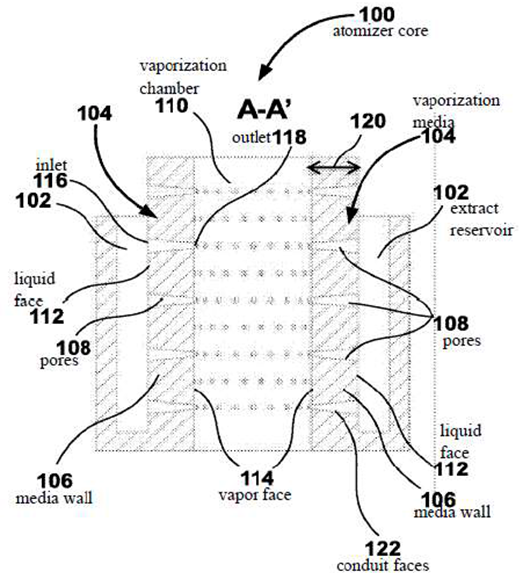
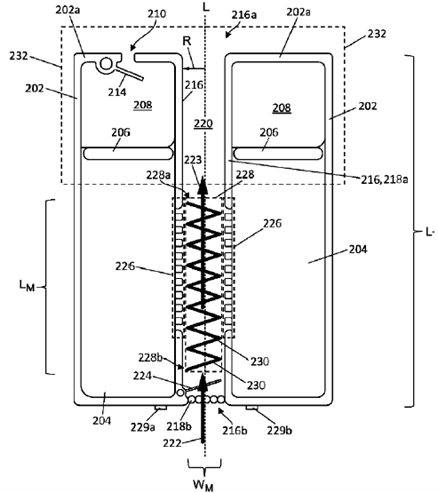
The PTAB juxtaposed representative figures from the primary and secondary references as below.
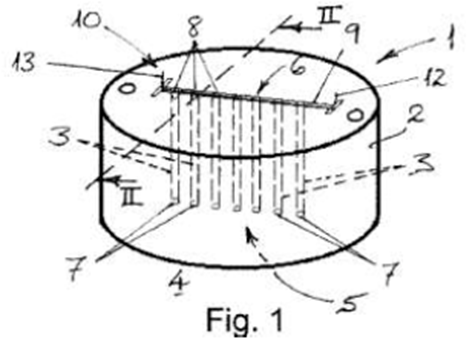
The PTAB quoted language from the secondary reference relies on capillary action concluding that the secondary reference’s supply channels (3) are capillary slots between plate elements (16) having outlet ends (6) with outer surfaces that are chamfered or tapered toward their outlet openings (8) to reduce a surface area of the plate elements (16) at their outlet end (6), thereby reducing the tendency of facing end surfaces of the plate elements (16) at their outlet end (6) to collect or accumulate an excessive volume of the liquid to be heated by an elongated heating element (11) extending perpendicular to the plate elements (16) at their outlet end (6).
Citing to the applicant’s argument that “the change in size does in fact result in a difference in performance, as claimed ‘to prevent liquid from flowing into the vaporization chamber while allowing vapor into the vaporization chamber,’” the PTAB concluded (bold italics mine) that “the record indicates that Examiner has not set forth a factual basis that is sufficient to support a conclusion that it would have been prima facie obvious … to make [the secondary reference]’s supply channels (3) decrease in diameter from their inlet to their outlet.”
Thus, with little detailed explanation, the PTAB reversed the examiner’s position apparently based upon the secondary reference’s holes having only capillaries “chamfered or tapered toward their outlet openings,” rather than explicitly having a frustum shape and decreasing in diameter from one end to the other, and possibly that such a shape would alter or interfere with the secondary reference’s function.
This case indicates that, at least in certain circumstances, to support a prima facie obviousness position, USPTO examiners need a proposed modification to be in accord with the purpose of the reference relied upon, and cannot be merely constructed out of an overlap in two different (even if overlapping) dimensional ranges. Here, the outlets being smaller than the inlets corresponded dimensionally to the secondary reference’s tapering, but such tapering to “prevent excessive accumulation” in the secondary reference did not correspond to the function of the primary reference or the claims. Accordingly, the PTAB did not find the overlapping ranges obvious.