Different Mechanism Leads to Lack of Reasonable Expectation of Success
September 23, 2025
The Patent Trial and Appeal Board recently reversed an obviousness finding of (at least initially non-signatory) Examiner Audrey Buttice, supported by Supervisory Patent Examienr (SPE) Joanne Hama and Office of Patent Quality Assurance (OPQA) official, Jeffrey Siew, for a method of treating a drug-resistant cancer type with an antibody-drug conjugate (ADC) in Ex part Yonesaka, et al., Appl. No. 16/485,777 (Appeal 2024-003040; Technology Center 1600).
The original claims in the application in question related to a “therapeutic method for EGFR-TKI-resistant non-small cell lung cancer, comprising administering an anti-HER3 antibody-drug conjugate to a subject in need thereof,” after preliminary amendment upon entering the US national stage. The HER are “human epidermal growth factor receptors” or transmembrane proteins, mutations of which have been associated with certain cancers. Presently, it appears that at least four HER are known. The original claims were not amended after an initial and second obviousness rejection, signed by SPE Joanne Hama, based on WO 2015/155998 A1 (Hettmann), Oncogene 2016, 35, 878-886 (Yonesaka), and optionally OncoTargets Ther. 2016, 9, 6065-6074 (van der Steen), but after an Advisory Action, the claims were amended with an RCE to recite “therapeutic method for osimertinib EGFR-TKI-resistant non-small cell lung cancer, comprising administering an anti-HER3 antibody-drug conjugate to a human subject in need thereof.”
Osimertinib
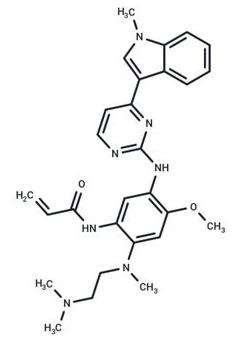
The amended claims were rejected over the combination of originally-cited Hettmann, originally-cited Yonesaka, and Oncotarget 2016, 7(49), 81598-81610 (Tang). Similarly to the initial office action, the examiner argued that
[Hettmann] teaches anti-HER3 antibody-drug conjugates (page 228, claim 1, “An anti body-drug conjugate wherein an antitumor compounded .... is conjugated to an anti-HER3 antibody”) as a treatment for lung cancer (page 235, claim 38, “the composition ... which is applied to lung cancer ...). The antibody in the antibody drug conjugate taught by [Hettmann] is a human antibody (U1-59; page 19, [0037]) and was tested inhuman lung cancer cell lines (page 20, paragraph 4, Fig.10) which would lead an ordinarily skilled artisan to conclude that the intended subject is a human subject.
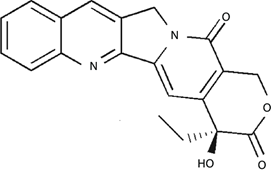
The anti-HER3 antibody-drug conjugate disclosed in [Hettmann] consists of an anti-HER3 antibody (page 4-5, paragraph [0012]) linked to a water-soluble derivative of the drug camptothecin [shown below]
[ ]
]
(page 1, paragraphs [0003] and [0004]). [Hettmann] teaches that the use of this drug is beneficial for cancer treatment as it does not require activation for exerting antitumor effect, has a high inhibitory activity, is active against various cancer cells, and exhibits effect against cells which are resistant to treatment due to expression of a glycoprotein (page 2, paragraph [0005]). [Hettmann] further teaches that the anti-HER3 antibody is an antibody capable of targeting tumor cells and that by using the anti-HER3 antibody in the drug conjugate, the drug is specifically delivered to the tumor cells allowing for reduced dose and less influence on normal cells. [Hettmann] also states that the anti-HER3 antibody is expected to enhance cytocidal effects (pages 4-5, paragraph [0012]).
[Hettmann], however, does not disclose that the anti-HER3 antibody-drug conjugate is used for the treatment of EGFR-TKI [epidermal growth factor receptor (EGFR) tyrosine kinase inhibitor (TKI)]-resistant, particularly osimertinib-resistant, non-small cell lung cancer.
Yoneska teaches a therapeutic method for treating patients with EGFR-TKI-resistant non-small cell lung cancer using patritumab, a monoclonal antibody against HER3 (anti-HER3 antibody) (abstract). Yoneska teaches that the glycoprotein heregulin, the HER3 ligand (page 878, left column, paragraph 1), was upregulated in tissue samples from patients who had TKI-resistant NSCLC (abstract). Yoneska teaches that heregulin is locally secreted and induces HER3 activation through an autocrine mechanism and that HER3 can also be activated by the dysregulation of other tyrosine kinase receptors (page 878, left column, paragraph 1). Yoneska teaches that EGFR-TKIs show robust effects on NSCLC but that cells eventually acquire resistance in approximately half of the cases contributed to both mutations in the EGFR kinase domain as well as HER3. Yoneska teaches that amplification of the MET oncogene can activate HER3, thereby switching on downstream phosphoinositide 3-kinase/AKT survival mechanisms, even in the presence of an EGFR-TKI (page 878, right column, paragraph 2). Yoneska teaches that because of this, targeting HER3 may help prevent the development of cancer cell resistance to EGFR-TKIs (paragraph bridging pages 878 and 879). To test this, Yoneska evaluated the antitumor efficacy of patritumab in NSCLC as a single agent and in combination with established EGFR inhibitors (page 879, left column, paragraph 1). Yoneska teaches that “patritumab can overcome heregulin-dependent EGFR inhibitor resistance in NSCLC in vitro and in vivo and suggest that it can be used in combination with EGFR-TKIs to treat a subset of heregulin-overexpressing NSCLC patients” (abstract).
Thus, the examiner essentially argued that because one antibody-drug conjugate, i.e., anti-HER3 antibody-camptothecin, from the primary reference was indicated to be active against various cancer cells resistant to treatment due to expression of a glycoprotein, such an antibody-drug conjugate would be obvious to use against EGFR-TKI resistance. The examiner acknowledged that the primary and secondary references did not indicate that the EGFR-TKI resistance was osimertinib resistance.
osimertinib
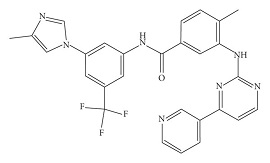
The examiner argued that a tertiary reference (Tang) “teaches that Osimertinib (OSI…) is the newest FDA-approved epidermal growth factor receptor (EGFR) tyrosine kinase inhibitor for non-small cell lung cancer (NSCLC) in patients with EGFR mutations,” and “proposes that the loss of EGFR could be a possible mechanism of resistance to OSI (page 81606, right column, paragraph 3).” The examiner thus rationalized that a person of ordinary skill in the art “would have had a reasonable expectation of success in making this combination and of treating osimertinib-resistant NSCLC as the prior art demonstrates that the EGFR-TKI resistance mechanisms are similar between osimertinib and other EGFR-TKIs and can be overcome by additionally targeting HER3.”
The applicant noted in the response to the rejections the acknowledgement in the office action that combined art failed to “explicitly implicate HER3 as a potential contributor to osimertinib resistance in NSCLC or the use of an anti-HER3 antibody to overcome this resistance,” while pointing to evidence in the form of a third-party academic publication “showing that the resistance pathways are complex, overlapping, and involve numerous other targets aside from HER3,” and the indication in a reference previously relied upon against the claims that “resistance to one EGFR-TKI is not predictive of whether that same cancer would be resistant to all EGFR-TKIs.” The applicant argued that the rejection was based on hindsight and essentially that the modification of the cited art to reflect the claims was unpredictable.
In a Pre-Appeal Brief Request for Review, the applicant argued the above and that (emphasis original) it was “scientifically and legally improper to assume that resistance to one EGFR-TKI can predict what treatments will be successful in a cancer that is resistance to a different EGFR-TKI.” The applicant further noted, as evidenced by the third-party academic reference, that
ERK and AKT lie downstream of numerous receptors (e.g., ADAMs, EGFR, HER2, c-Met, IGF-lR, etc.) and other signalling molecules (e.g., PBL, Ras, Raf, MEK, etc.). Accordingly, a person of ordinary skill would not reasonably expect, based on Tang's alleged teaching of “inhibiting the phosphorylation of ERK and AKT in NCI-Hl975 cells,” that an anti-HER3 antibody-drug conjugate could successfully treat osimertinib-resistant NSCLC.
The applicant noted a further third-party academic reference that shows a breakdown of resistance mechanisms to osimertinib in EGFR-mutated NSCLC patient samples and it fails to mention HER3, and that the examiner dismissed this evidence as “a single reference … not necessarily reflective of what would have been obvious to a skilled artisan prior to the effective filing date of the claimed invention.” The applicant noted that
[i]t strains credulity to assert that the a person of ordinary skill possesses the requisite motivation to treat osimertinib-resistant NSCLC with an anti-HER3 antibody drug conjugate and have a reasonably expectation of successfully doing so in the absence of any specific implication that HER3 is a suitable target, either before or after the filing of this application.
The examining corps panel was not persuaded by these arguments, which were substantially reproduced in the appeal brief and reply brief.
The PTAB found in favor of the applicant / appellant, noting the applicant’s argument that anti-HER3 taught in Yonesaka acts differently than the antibody-drug conjugate (ADC) of the present invention, and stating agreement with the applicant, given the knowledge in the art evidenced by the applicant’s third-party reference(s), a person of ordinary skill in the art would not have been motivated to treat osimertinib-resistant NSCLC with the claimed anti-HER3 antibody drug conjugate.
The reversal of the obviousness rejection in this case illustrates that the PTAB can be more receptive to evidence of unpredictability and more understanding of the status of research in the art, while the USPTO examining corps is often inclined to retrace the solution claimed in an application back through dispersed disclosures in the art in an improbable, hindsight-based manner, treating any suggestion in the art of a possible solution as a predictable teaching and disregarding any evidence provided by the applicant contradicting the examiner and SPE’s hypothesis.
Particularly regarding pharmaceutical inventions, the USPTO supervisory examiners seem to overestimate the predictability in the art and stubbornly adhere to suggestions for research in the hindsight-viewed prior art as predictable instructions for an applicant’s research results. Providing third-party evidence of the unpredictability of the research record in the art and showing distinctions between the prior art proposals and the ultimate solution are generally helpful in clarifying the record, but it may be necessary to appeal the examining corps’ position to get a fair analysis of the claimed invention.